 Most viewed - eBook Library Most viewed - eBook Library |

intuitive-awareness.pdfIntuitive Awareness5198 viewsThis book is a small sample of the talks that Ajahn Sumedho offered during the winter retreat of 2001. The aim of the editors in compiling this book has been explicitly to maintain the style and spirit of the spoken word. As Ajahn Sumedho himself commented, The book is meant to be suggestions of ways to investigate conscious experience. It's not meant to be a didactic treatise on Pali Buddhism.
|
|
10_ways_of_making_merit.pdfTen Ways of Making Merit5182 viewsThe Buddha taught that merit-making is a formidable antidote to overcome the many vicissitudes faced in our day-to-day lives. Hence He declared: ‘Do not fear merit-making. “Merit-making†is a term denoting happiness, what is desirable, pleasant, dear and charming. For I recall in my mind very well that after making merit for a long time, I experienced desirable, pleasant, dear and charming results for a long time. Let therefore a man train himself in merit-making that yields long-lasting happiness. Let him cultivate the practice of giving, virtuous conduct and a mind of metta. By cultivating these qualities the wise man arrives in untroubled and happy states.
|
|
03Basic_Instructions.pdfBasic Instructions for Vipassana Meditation 5182 viewsFrom the beginning and throughout the practice sessions the strategies and fundamentals of Vipassana meditation will be given so that you become well established in the essentials of the techniques involved. Then it is important that the meditator understands the practice in its context. So a frame of reference is necessary, in the form of a framework to the practice as given by the Buddha in his teaching in the Satipatthana Sutta or the discourse on The Four Foundations of Mindfulness.
|
|
bud-myanmar.pdfBuddhism in Myanmar - A Short History5137 viewsThis book traces the earliest contact with Buddhism in Mayanmar (Burma); the Mon and Pyu Kingdoms. Theravada Buddhism comes to Pagan; Pagan: its flowering and decline. The Shan rule. The Mayanmar build an Empire. The Eighteenth and Nineteenth Centuries.
|
|
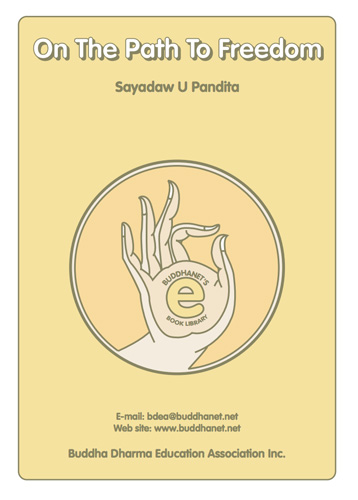
path-free.pdfOn The Path To Freedom5133 viewsOn The Path to Freedom - a mind of wise discernment and openness - by Burmese Meditation Master, Sayadaw U Pandita. This is a compilation of Dhamma discourses to foreign meditators at the Mahasi Meditation Centre, Rangoon, Myanmar, who came to practise under him in Yangon (formerly Rangoon) between August 1986 to March 1987. Translated from Myanmar by the late Mya Thaung.
|
|
mindocean.pdfMake Your Mind an Ocean5124 viewsTo enter the spiritual path, you must begin to understand your own mental attitude and how your mind perceives things. If you're all caught up in attachment to tiny atoms, your limited, craving mind will make it impossible for you to enjoy life's pleasures. External energy is so incredibly limited that if you allow yourself to be bound by it, your mind itself will become just as limited. When your mind is narrow, small things easily agitate you. In this series of lectures, Lama speaks on the nature of mind and the Buddhist approach to mental health. Of particular interest here is 'A Buddhist Approach to Mental Illness', a talk Lama gave to a group of Western mental health practitioners, and which highlights the differences between the two approaches to mental health and perhaps lays the foundation for a greater understanding between the two.
|
|
budartthai2.pdfBuddhist Arts in Thailand5070 viewsThis is a study of the development of Art and Architecture in Thailand with Buddhism. The Culture of Thailand has two important sources of origin: indigenous and foreign. The indigenous source comes directly from the ideas and inspiration of the people while the foreign sources came through its cultural contact with other great civilised nations such as India and China. In the field of art, it mainly deals with religions such as Buddhism and the cultural and artistic relationship with India, and other countries. Thai art served religion, which formed the national ideal and conception of life.
|
|
gates_of_chan.pdfThe Gates of Ch'an Buddhism5009 viewsVenerable Jing Hui
Bodhidharma's Gate: Ch'an (Zen) in fact is an impregnable fortress, without a gate to enter. Suppose there is really a gate, that gate would simply be a method of training to be taken up in the Ch'an tradition. That is why when a monk asked Master Zhao Zhou(778-897: "Has a dog Buddha-nature or not?" Master Zhao Zhou retorted: "Wu". Later on,this Gongan (koan) formed part of a specific approach in the Ch'an School. The author,Venerable Jing Hui is a Ch'an Master and a vice-president of the Buddhist Association of China.
|
|
DeadNightEng.pdfIn the Dead of Night4989 viewsI had been driving all day on a long, lonely, dusty road. Night had already fallen when I decided to rest. I still had a long way to go and I felt very tired. This book deals with people's fear and emotions with some scary, but humorous illustrations by Joel Israel. [42 pages]
|
|
allexistence.pdfThe 31 Planes of Existence4979 viewsThe suttas describe the 31 distinct planes or realms of existence into which beings can be reborn during their long wanderings through samsara. These range from the extraordinarily dark, grim, and painful hell realms all the way up to the most sublime, refined and exquisitely blissful heavenly realms. Existence in every realm is impermanent; in the cosmology taught by the Buddha there is no eternal heaven or hell. Beings are born into a particular realm according to both their past kamma.
|
|
| 347 files on 35 page(s) |
 |
|
|
9 | |
|
|
|





















 Social Bookmarks


