 Top rated Top rated |

25_Track_25.mp3FARE-YE-WELL1775 viewsMy fond young wife, oh fare-ye-well,
I leave your side to come again,
A sage of sages, king of kings,
This holy hour tho’full of pain.
This palace vast is small to me,
I cannot breathe nor lie at rest,
The vaster world bids me to leave,
This vanity for what is best.
So fare thee well, my only son,
Reclining in the mother’s arms,
I go to build the realm of truth,
Hence leave I all with folded palms.
And mount my horse, and fly thro’s Time,
To conquer pain and birth and death,
To find a way to reach that bliss,
I leave behind this passing wealth!
(repeat the first verse)
 
(7 votes)
|
|
13_Track_13.mp3RIGHT ACTION2068 viewsFirm in our purpose we have act,
Our feet in Wisdom’s Way;
Nor shall the transient things of earth,
Our resolution sway.
We spurn the lure of fame or gold,
The lust for things of sense;
And find purity and peace,
Our ample recompense.
Unselfish love to all that live,
Our lives shall manifest;
In thought, in word, in action show,
Its inspiration blest.
Though steep and toilsome be the path,
We shall but strive the more;
Nirvana’s holy realm to gain,
And peace forevermore.
(7 votes)
|
|
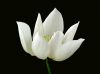
10white_lotus.jpgWhite Lotus 102810 viewsWhite Lotus 10
(7 votes)
|
|

dhammapadatxt1.pdfTreasury of Truth - Dhammapada3309 viewsVen. Weragoda Sarada Maha Thero
This work lends itself readily to an in-depth study of this religious classic of mankind, to the great delight of both the scholar and the student. This PDF file is the text version only of the Illustrated Dhammapada by Ven. Sarada Maha Thero. The Pali text has explanatory translation of the verses with commentary in English.
(7 votes)
|
|
essentialsof.pdfEssentials of Buddhism4520 viewsIt is based on the Theravada Buddhism syllabus of the Postgraduate Diploma Examination in Buddhist Studies course of the Buddhist and Pali University of Sri Lanka. Since the work is meant for students, every chapter appears as a unit by itself and is confined to a few pages. Ven. Ganarama is the Principal of the Buddhist and Pali College of Singapore.
(7 votes)
|
|
nibbana1.pdfThe Practice which Leads to Nibbana3672 viewsVen. Pa-Auk Sayadaw
Translated by Greg Kleiman. This is the method of practising meditation that is taught at Pa Auk Tawya Monastery, (Myanmar) Burma. It is based on the explanation of meditation found in the Visuddhimagga commentary. Because of that the method involves several stages of practice which are complex, and involved. These stages include a detailed analysis of both mentality and matter, according to all the categories enumerated in the Abhidhamma, and the further use of this understanding to discern the process of Dependent Origination as it occurs in the Past, Present, and Future. Therefore people who are unfamiliar with the Visuddhimagga and the Abhidhamma will have difficulty in understanding and developing a clear picture of the practice of meditation at Pa Auk Tawya. For foreigners who cannot speak Burmese this problem is made even more difficult. This introduction has been written to help alleviate these difficulties by presenting a simplified example of a successful meditator's path of progress as he develops his meditation at Pa Auk Tawya.
(7 votes)
|
|
frames_ref.pdfFrames of Reference4833 viewsThis book on the frames of reference is based to some extent on my own thoughts and opinions. In some spots it may not be directly in line with the original text (Satipatthana Sutta), because my primary aim has been to get to the heart of the matter, so that it can be conveniently put into practice. The eBook also includes a section on the Duties of the Sangha, that is, the laws and regulations and disciplinary standards (Vinaya).
(7 votes)
|
|
BT01A.MP3Lecture 1. (a) The Buddha10425 viewsThis course consists of 10 lectures on the fundamentals of the Buddha’s Teachings, the Dhamma:
The lectures explain the Dhamma from the perspective of Theravada Buddhism, the oldest continuous Buddhist school, whose scriptures, the Pali canon, give the most accurate picture of what the historical Buddha himself actually taught. The lectures are intended to be basic enough to be of value to beginners without previous study of the Dhamma, and deep and through enough to be of interest to long-term students seeking to extend and clarify their understanding.
(53 votes)
|
|

20_tara.jpgThe 21 Taras (20)2263 viewsThe 21 Taras [Tibetan style] (Tibetan, Sgrol-ma)
It was not until the adoption of the Yogachara system, taught by Asanga in the fourth century AD, that the feminine principle began to be venerated in Mahayana Buddhism. Around the sixth century, the goddess Tara was considered as a Sakti of Avalokitesvara (sometimes as his wife).
(9 votes)
|
|
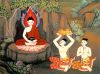
buddha_life_16.jpgThe First Two Lay Followers3708 viewsThe First Two Lay Followers
(9 votes)
|
|
| 985 files on 99 page(s) |
 |
|
|
33 | |
|
|
|





















 Social Bookmarks


