 Top rated Top rated |
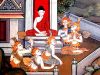
buddha_life_9.jpgThe Practice of Austerities3057 viewsThe Practice of Austerities 
(6 votes)
|
|

buddha_life_07.gifThe Prince in an act of renuciation, cuts His hair4934 viewsThe Prince in an act of renuciation, cuts His hair
(6 votes)
|
|

ordination.pdfOrdination Procedure3475 viewsPali / English
Ordination Procedure, was composed by Somdet Phra Sangharja Pussadeva of Wat Rajapratisahasthitamahasmarama. His Eminence reformed some of the text and procedure for Pabbajja and Upasampada from the original text. The method of Pabbajja (Going-forth) and Upasampada (Acceptance) in the Southern School (that is, Theravada) uses the original Magadha (Pali) language.
(6 votes)
|
|
milinda.pdfThe Debate of King Milinda (The Milanda Panna)3170 viewsThe Milanda Panna is a famous work of Buddhist literature, probably compiled in the 1st century B.C. It presents Buddhist doctrine in a very attractive and memorable form as a dialogue between a Bactrian Greek king, Milinda, who plays the 'Devil's Advocate' and a Buddhist sage, Nagasena. The topics covered include most of the questions commonly asked by Westerners. This abridgement provides a concise presentation of this masterpiece of Buddhist literature.
(6 votes)
|
|
mission-accomplished.pdfThe Mission Accomplished2471 viewsA historical analysis of the Mahaparinibbana Sutta of the Digha Nikaya of the Pali Canon. The Mission Accomplished is undoubtedly an eye opening contribution to Buddhist analytical Pali studies. In this analytical and critical work Ven. Dr. Pategama Gnanarama enlightens us in many areas of subjects hitherto unexplored by scholars. His views on the beginnings of the Bhikkhuni Order are interesting and refreshing. They might even be provocative to traditional readers, yet be challenging to the feminists to adopt a most positive attitude to the problem. Prof. Chandima Wijebandara, University of Sri Jayawardhanapura, Sri Lanka.
(6 votes)
|
|
damachak.pdfDhammacakkappavattana Sutta5583 viewsVen. Mahasi Sayadaw
The First Discourse of the Buddha, namely the Dhammacakkappavattana Sutta, commonly known as the Great Discourse on the Wheel of Dhamma. This is a series of discourses on the Dhammacakka Sutta by the late Venerable Mahasi Sayadaw, a Questioner at the Sixth Buddhist Council in Myanmar, (Burma) 1954. Translated by U Ko Lay.
(6 votes)
|
|

v_retreat6.pdfThe Vipassana Retreat4595 viewsVen. Pannyavaro
Vipassana meditation requires long-term commitment. While it can be done to some extent in everyday life, realistically for the practice to deepen it needs to be done intensively in a supportive retreat situation. Vipassana meditation is developmental, so to realise its ultimate benefit it has to be sustained with appropriate intensity under supportive conditions. Ven. Pannyavaro, a practitioner of over 30 years, guides you through the vipassana experience in a retreat situation, in a systematic and practical way.
(6 votes)
|
|

07_Inspiration.mp37. Truth Within You (Songs)1417 views
(3 votes)
|
|
10_Culture_web.pdfVolume 10. Korean Buddhist Culture1789 viewsAccounts of a pilgrimage, monuments, and eminent monks.
(3 votes)
|
|
geth0401.pdfCan Killing a Living Being Ever Be an Act of Compassion?4660 viewsThe analysis of the act of killing in the Abhidhamma & Pali Commentaries.
Abstract: In the Theravadin exegetical tradition, the notion that intentionally killing a living being is wrong involves a claim that when certain mental states (such as compassion) are present in the mind, it is simply impossible that one could act in certain ways (such as to intentionally kill). Contrary to what Keown has claimed, the only criterion for judging whether an act is “moral†(kusala) or “immoral†(akusala) in Indian systematic Buddhist thought is the quality of the intention that motivates it. The idea that killing a living being might be a solution to the problem of suffering runs counter to the Buddhist emphasis on dukkha as a reality that must be understood. The cultivation of friendliness in the face of suffering is seen as something that can bring beneficial effects for self and others in a situation where it might seem that compassion should lead one to kill.
(3 votes)
|
|
| 985 files on 99 page(s) |
 |
|
|
42 | |
|
|
|























 Social Bookmarks


